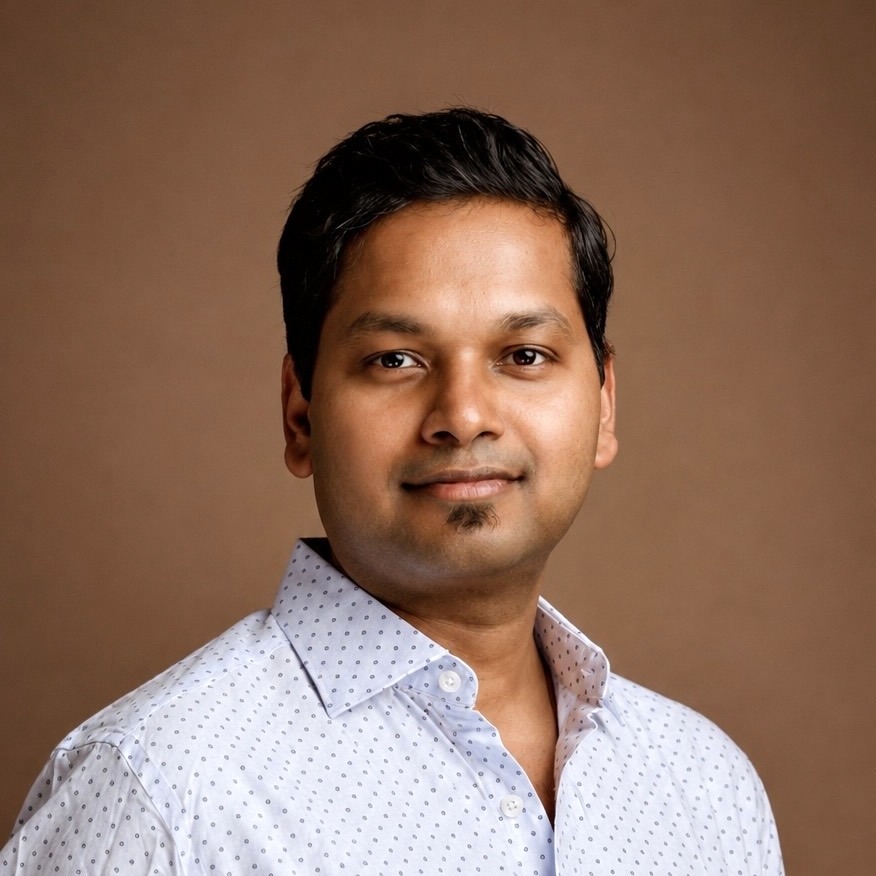
Pyaree Mohan DashGermany · Open to global collaboration
REGULATORY LANDSCAPE / MPRA SIGNALMove your pointer across the track →
A T G C C A T T A G G C A A C G T C C T A G A A T G C G G A C T A A C G T T A
Regulatory genomicsVariant-effect prediction, MPRA, and interpretable genomic AI.
Reproducible systemsResearch workflows that move from raw reads to usable evidence.
Translational thinkingComputational prioritization designed for experimental follow-through.
01 / About
Three roles. One connected practice.
My work sits where computational method, biological interpretation, and reliable delivery meet. I can investigate the question, build the system, and explain what the result means.
A / 01
Analyst
I make complex biological data legible, comparable, and decision-ready.
Connected model predictions to biologically meaningful regulatory signals.
Identified GPCR ligand-binding residues through integrated structural analysis.
Used time-series disease simulations to surface candidate biomarkers.
D / 02
Developer
I turn one-off analyses into reproducible tools, pipelines, and research infrastructure.
Co-built MPRAsnakeflow for quality-controlled analysis of 240,000 variants.
Built an integrated GPCR structure-drug-ligand knowledge base.
Work across Python, R, Bash, workflow engines, containers, APIs, and cloud.
S / 03
Scientist
I design focused computational strategies that survive biological and experimental scrutiny.
Improved variant-effect prediction correlation by 60% with a focused CNN.
Prioritized heart-targeting candidates validated in mice and pigs.
Reconstructed FPR receptor evolution across 19 species.
02 / Experience
Research experience
A trajectory from systems biology and receptor evolution to scalable genomics, AI, and translational gene delivery.
2025Present
Research Assistant · Part-time
University Hospital Heidelberg
Heidelberg, Germany
Precision cardiac gene delivery
Developed a multimodal framework to identify heart-targeting gene-delivery candidates with strong translational potential; leading candidates were successfully validated in mice and pigs.
Elucidated candidate biological drivers, providing a reusable strategy to prioritize next-generation delivery vectors.
20212025
Bioinformatics Scientist
Berlin Institute of Health at Charité
Berlin, Germany
Variant effects · High-throughput genomics
Designed a scalable variant-effect prediction framework spanning linear, ensemble, and large DNA foundation models; a task-specific CNN improved Pearson correlation by 60% over the larger models.
Developed interpretation algorithms connecting predictions to biologically meaningful regulatory signals, strengthening candidate selection and downstream validation.
Co-built MPRAsnakeflow, converting raw Illumina data into quality-controlled measurements, reports, and visualizations for 240,000 variants.
Led pilot studies establishing an AI-guided framework for disease-relevant variant design and analysis, laying groundwork for adoption within NHGRI-IGVF.
Built a model-guided framework ranking enhancers and variants by predicted effect size and delivering experiment-ready candidates for targeted gene-delivery studies.
20182021
Graduate Research Assistant
CIPMM Homburg · HS-KL
Saarland, Germany
Immune receptor evolution and function
Reconstructed the evolutionary landscape of bacterial FPR immune-receptor families across 19 species and traced how diversification shaped immune-signaling roles.
Combined high-throughput cellular screening and bio-imaging analysis to identify novel receptor-specific peptide binders.
20192020
Graduate Research Assistant
Helmholtz Institute for Pharmaceutical Research Saarland
Saarbrücken, Germany
Drug bioinformatics
Built an integrated GPCR structure-drug-ligand knowledge base for graph-based receptor-ligand analysis and drug-target discovery.
Contributed to a Bill & Melinda Gates Foundation-funded project developing biocontrol-based disinfection technologies for regions facing sanitation and wastewater challenges.
03 / Impact atlas
Work translated into usable results.
Filter the atlas by the kind of problem solved. Each card represents a concrete result from my research or academic projects.
Gene delivery01
Heart-targeting candidates advanced to in-vivo validation.
Multimodal prioritization produced candidates with strong translational potential, successfully validated in mice and pigs.
Biological insight02
Explained candidate performance.
Biological drivers became a reusable strategy for selecting next-generation delivery vectors.
Variant effects03
+60%
Focused model design beat scale.
A task-specific CNN improved correlation over larger DNA foundation models.
Explainable AI04
Predictions became biological signals.
Interpretation algorithms sharpened candidate selection and downstream experimental validation.
High-throughput genomics05
240K
Reproducible MPRA analysis at scale.
MPRAsnakeflow converts raw Illumina reads into QC measurements, reports, and visualizations.
Consortium science06
AI-guided variant design for IGVF.
Pilot studies laid the groundwork for consortium-wide disease-variant design and analysis.
Experimental design07
Experiment-ready enhancers and variants.
An end-to-end framework ranked candidates by predicted effect size for targeted studies.
Evolution08
19 species
The FPR receptor landscape reconstructed.
Evolutionary analysis traced functional diversification across immune-receptor families.
Cell screening09
Novel receptor-specific peptide binders.
High-throughput cellular screening combined with mammalian-cell bio-imaging analysis.
Knowledge systems10
A graph-ready GPCR knowledge base.
Integrated structure, drug, and ligand evidence for receptor analysis and discovery.
Invited and selected work at international computational-biology conferences.
2024RSG Chair
ISMB · RSGDREAM
Accelerating high-throughput characterization of regulatory variants with deep learning.
Dash, Deng, Shendure, Ahituv, Schubach & Kircher
2023MLCSB Chair
ISMB / ECCB
Massively parallel characterization of transcriptional regulatory elements.
Agarwal, Inoue, Schubach, Penzar, Martin, Dash, et al.
08 / Recognition & service
Contribution beyond the analysis
2022
Honorable mention
Invited poster at the ISCB RSG conference with DREAM Challenges.
2021
Featured research
Master's thesis featured at the Upper-Rhine Artificial Intelligence Symposium.
2016 · 2017
Research fellowship
Indian Academy of Science fellowship; approximately 250 students selected across India.
2023 · 2024
Peer reviewer
Reviewer for Bioinformatics and Bioinformatics Advances, Oxford University Press.
2024
Workshop organizer
Co-organized an international IGVF workshop on MPRA design for AI applications.
2018 · 2021
Mentorship
Co-supervised two bachelor's students and one master's student at CIPMM.
09 / Contact
Bring me a hard biological problem.
Available for selected roles and consulting collaborations across bioinformatics analysis, genomic AI, workflow development, research strategy, and scientific communication.